Hemp/jute fibre mats
Insulation boards
Mats for thermal insulation
Loose-fill and blow-in insulation materials
Speciality products
Features
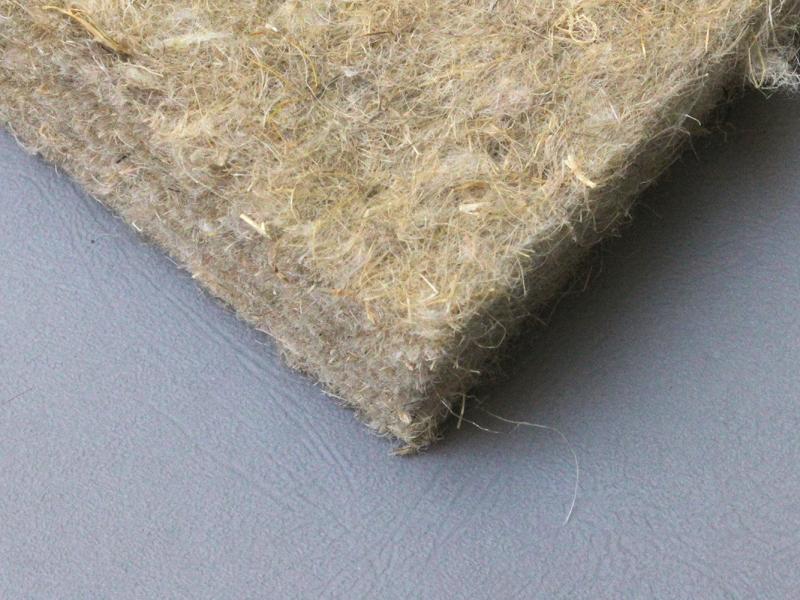
Hemp and jute fibre mats provide insulation against heat, cold and sound. Thanks to their high absorbency, they also help to regulate humidity. Their main area of application is internal insulation. They can be used for insulation between, above and below rafters, as well as for insulating timber-beamed ceilings, external and internal walls in timber-frame and timber-stud construction, metal stud walls, cladding, external wall insulation between a load-bearing structure, insulation on non-accessible but reachable top-floor ceilings, cavity insulation between joists in floor structures and similar substructures. Hemp insulation materials are now only available in combination with, for example, jute fibres
Raw materials and manufacturing processes
Raw materials: hemp fibres, Biko fibres or maize fibres, soda or ammonium phosphate
Technical Specifications
Property | Unit | Parameters | ||
|---|---|---|---|---|
| Thermal conductivity λB | W/(mK) | 0.041 | 0.042 | 0.047 |
| Bulk density ρ | kg/m³ | 39 | 24 | 40 |
| Heat capacity c | J/(kgK) | 2300 | 1600–1700 | 1700 |
| Building material class | -- | B2 | B2 | B2 |
| Water vapour diffusion resistance μ | -- | 1–2 | 1.9 | 1–2 |
| Primary energy content | kWh/m³ | 48–67 | 40 | 64 |
| Water-repellent effect | -- | no | no | no |
*Comparative U-value: 1.0 W/(m²K)
If reuse is not possible, mats containing soda and maize fibres can be composted. Hemp fibre mats containing Biko fibres, on the other hand, cannot be composted. In this case, thermal recovery is a suitable option. Hemp-jute mats consist of 66% hemp fibres, 22% jute fibres, 8% PET-based polymer support fibres and 4% soda
. Availability:
The product is not available on the German market.
ETA-05/0037
Health and the Environment
Hemp is a native plant, meaning that transport distances between the farm and the processing facility are short. There are products on the market that contain no chemical ingredients whatsoever, being made from biofibres. Mats made from soda and maize fibres can even be composted. The product is therefore harmless from an environmental point of view. Nor are there any known health concerns.
- partially compostable
- sound-insulating
- summer heat protection
- several manufacturers
- moisture-regulating
- some of which contain biofibres
- relatively expensive
- medium insulation value

